How long does NAD IV therapy last?
NAD IV therapy effects typically last 4–14 days per session. Learn what affects duration, how often to go, and whether NMN supplements are a smarter alternative.
Your NAD+ levels are roughly half of what they were in your twenties. That single fact drives billions of dollars worth of longevity spending every year, from oral supplements to IV clinics that charge up to $1,000 per session. The question people ask before pulling out their credit card is always the same: how long does it actually last?
It's the right question. The answer is more nuanced than any IV clinic will tell you in their brochure. NAD IV effects typically last between 4 and 14 days for most people, but that range swings wildly depending on your age, your lifestyle, how much NAD you got, and whether you're doing anything to maintain levels between sessions. Some people feel nothing after a week. Others report benefits stretching into the second month.
This guide covers everything: the biology of why NAD+ declines, what actually happens during an infusion, what makes effects last longer, how NAD IV compares to NMN and NR supplements, what it costs, and whether the whole thing is worth it. No hype in either direction. Just what the research and clinical experience actually show.
Why NAD+ matters as you age
NAD+ isn't a trend. It's one of the most important molecules in your body. Every cell uses it, from your neurons to your muscle fibers to your skin. It sits at the center of energy production, DNA repair, and the regulation of nearly every aging pathway researchers have studied.
Here's what happens as you get older.
By the time you hit 40, your NAD+ levels have dropped to roughly 60% of what they were at 20. By 60, you're looking at about half. That decline isn't trivial. NAD+ powers the sirtuins, the family of proteins that regulate gene expression, inflammation, and metabolic function. It feeds the PARP enzymes that patch your DNA when it gets damaged. Without enough NAD+, these systems start to fail, and the downstream effects look a lot like aging: fatigue, brain fog, slower recovery, metabolic dysfunction, rising inflammation.
The mechanism works something like this. As you age, DNA damage accumulates. Your PARP enzymes activate to repair it, consuming massive amounts of NAD+ in the process. Simultaneously, an enzyme called CD38, which also degrades NAD+, becomes more active with age. The net result is a progressive NAD+ deficiency that compromises mitochondrial function, sirtuin activity, and cellular energy production all at once.
Sirtuins, especially SIRT1 and SIRT3, are worth understanding here. They're sometimes called longevity proteins, and their nickname is earned. They regulate mitochondrial biogenesis, suppress inflammation, improve insulin sensitivity, and activate stress-response pathways that protect cells. But they only work when NAD+ is available. No NAD+, no sirtuin activity. It's a direct dependency, and it's why restoring NAD+ levels has become one of the most actively researched interventions in longevity science.
The question isn't whether NAD+ matters. It does. The question is how to restore it effectively, and for how long.

What is NAD IV therapy?
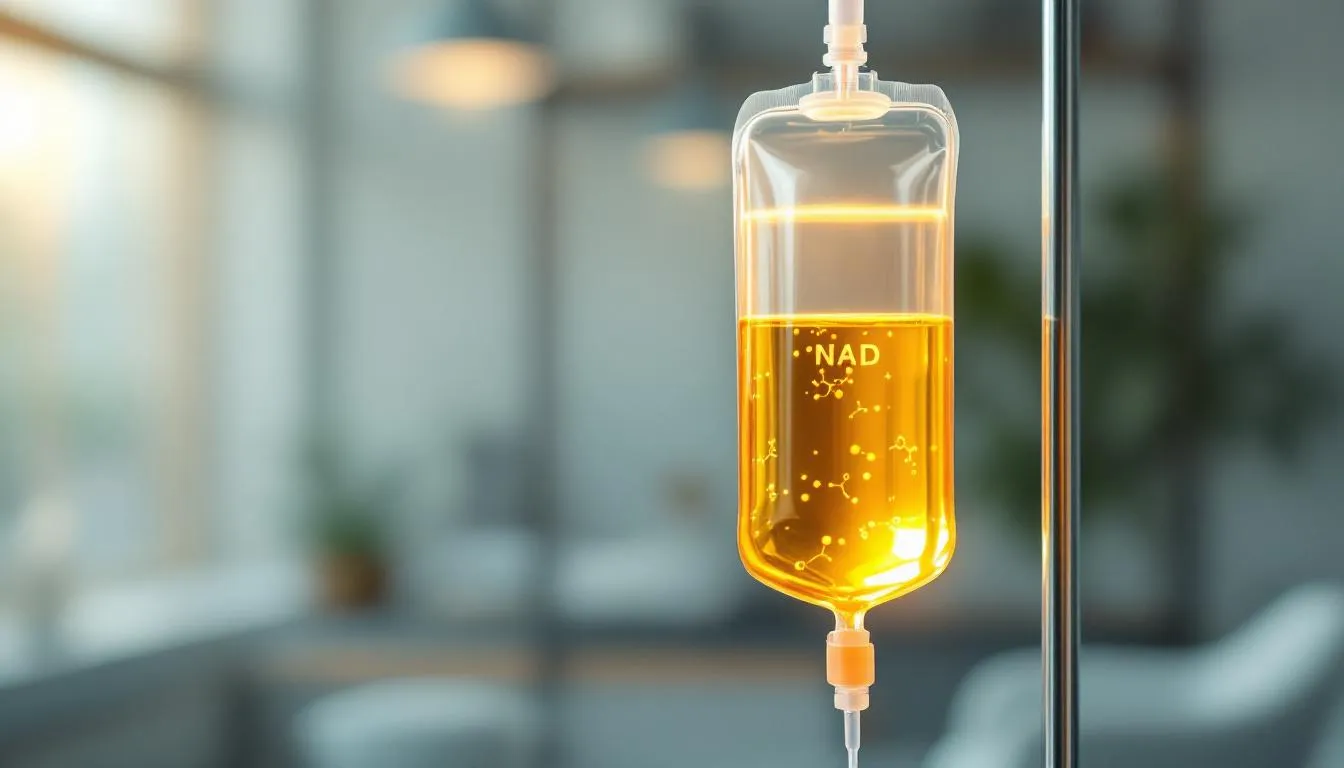
NAD IV therapy delivers NAD+ directly into your bloodstream through an intravenous infusion. You sit in a clinic for 2 to 4 hours while a saline drip loaded with nicotinamide adenine dinucleotide flows into your vein. It goes directly to your cells, bypassing the digestive system entirely.
The appeal is obvious. When you take NAD precursors orally, whether NMN or NR, your gut has to convert them through several enzymatic steps before they become usable NAD+. That process is effective, but it's not 100% efficient. IV delivery skips all of that. The bioavailability is essentially complete, which means every milligram you pay for reaches your bloodstream.
Clinics typically offer doses ranging from 250 mg to 1000 mg per session, with 500 mg being a common starting point. Higher doses generally produce more pronounced effects but also more side effects during the drip. Most clinics recommend slowing the infusion rate if you feel nausea, flushing, or chest tightness, all of which are common and generally harmless.
The experience itself isn't glamorous. You're sitting in a chair with a needle in your arm for hours. Many people work on their laptop or read. Some feel a warm flush or mild nausea during the infusion, particularly at higher doses or faster drip rates. Most feel a wave of calm energy in the hours following the session.
NAD IV therapy has been used clinically for decades in addiction medicine, where it showed promise for reducing withdrawal symptoms and cravings. The broader longevity and wellness application is newer, having caught significant mainstream attention in the past decade as research on NAD+ biology accelerated.
How long does NAD IV therapy last?
This is the question. And the honest answer is: it depends.
Most people who get a single NAD IV infusion report feeling effects for anywhere from 4 to 14 days. The most common experience is a noticeable boost in energy, mental clarity, and mood for about a week. After that, the effect fades. Some people experience a more sustained benefit lasting 3 to 6 weeks, particularly when they're doing multiple sessions close together at the start.
Here's why the range is so wide.
Your baseline NAD+ level
If you're severely NAD+ depleted, you have more room for improvement. A first infusion in someone who's chronically deficient can produce dramatic results that last longer than a "top-up" session in someone who already maintains decent levels. Think of it like rehydrating after being mildly thirsty versus severely dehydrated.
Dose
A 250 mg infusion and a 1000 mg infusion don't produce identical outcomes. Higher doses push more NAD+ into circulation, and the effects tend to be more pronounced and longer-lasting. But higher doses also increase the probability of side effects during the drip, so most clinics titrate based on your tolerance.
Your age and health status
Older people generally see more pronounced and longer-lasting benefits because they're working from a lower baseline. A 65-year-old with metabolic syndrome may notice effects for weeks. A 35-year-old biohacker who already takes NMN and eats well may feel a bump for 3 to 5 days before returning to their normal state.
What you do after
This one matters more than people realize. NAD+ is consumed constantly by your metabolism, your DNA repair machinery, and your immune system. If you're under chronic stress, sleeping poorly, eating processed food, and not exercising, you'll burn through the NAD+ from your infusion much faster. Conversely, people who support their NAD+ between sessions with oral precursors, good sleep, and regular exercise tend to sustain the effects longer.
The loading phase
Most experienced NAD clinicians don't recommend standalone sessions. They recommend what's called a loading phase: 3 to 5 consecutive daily or near-daily infusions at the start, followed by monthly maintenance sessions. This approach builds up NAD+ more substantially and establishes a higher baseline. People who do loading phases consistently report longer-lasting and more reliable effects than those who do occasional one-off sessions.
How often should you get NAD IV therapy?
The answer depends on your goals and your budget.
For general longevity maintenance, most clinics recommend monthly sessions after completing an initial loading phase. For people dealing with fatigue, cognitive decline, or post-illness recovery, more frequent sessions (every 1 to 2 weeks) are sometimes recommended for a period of a few months.
Here's a rough framework:
Loading phase (first month): 3 to 5 sessions spaced over 1 to 2 weeks. This builds a meaningful reservoir of NAD+ and establishes a higher baseline.
Maintenance (ongoing): 1 session per month is common. Some people drop to quarterly once they've stabilized their levels.
Therapeutic use (post-viral fatigue, cognitive issues, addiction recovery): Weekly to biweekly sessions for 1 to 3 months, then transitioning to monthly maintenance.
The caveat is cost. At $300 to $1,000 per session, a loading phase alone costs between $900 and $5,000. Monthly maintenance adds up fast. This is not an intervention most people can sustain indefinitely, which is why combining NAD IV with oral supplements is often the more practical long-term strategy.

NAD IV vs NMN supplements: which is better?
This is where the conversation gets complicated, because "better" depends entirely on what you're optimizing for.
Bioavailability: IV wins outright. Direct delivery to the bloodstream means 100% absorption. Oral NMN goes through your gut, where it's converted to NAD+ through a series of enzymatic steps. Newer sublingual and liposomal NMN formulations improve absorption, but they still can't match the efficiency of IV delivery.
Duration per dose: Comparable. A single NAD IV session and a month of daily NMN supplementation both raise NAD+ levels significantly. The difference is in how quickly you feel it.
Speed of effect: IV wins. Many people report feeling the effects within hours of an infusion. Oral NMN typically takes days to weeks before noticeable changes in energy and cognition.
Sustainability: NMN wins easily. At $1 to $3 per day, oral NMN is affordable for long-term daily use. NAD IV at $300 to $1,000 per session is a significant financial commitment.
Scientific evidence: Oral NMN and NR actually have more published human clinical trial data at this point. Multiple studies have confirmed that oral NMN at 250 to 500 mg per day raises blood NAD+ levels measurably and improves metabolic markers, muscle function, and cardiovascular parameters. The IV delivery format is used in clinical settings but has fewer controlled human trials specifically.
The expert split: This is where it gets interesting. Some longevity-focused physicians, including those at major clinics, advocate strongly for NAD IV as the most efficient delivery method. Others, including Dr. Eric Verdin at the Buck Institute for Research on Aging, argue that oral precursors are actually more practical and equally effective because NAD+ itself is too large to enter cells directly and is largely broken down in the bloodstream anyway. The precursors (NMN, NR) may actually be more cell-permeable.
The practical conclusion for most people: oral NMN or NR daily is the foundation. Periodic NAD IV can serve as a boost, particularly when you need faster or more pronounced effects, or when recovering from illness, major surgery, or intense athletic training.
WinAging covers the research on NMN and NAD precursors extensively. If you're building a longevity stack from scratch, understanding how these compounds fit together matters more than any single delivery method.
How much does NAD IV therapy cost?
Cost is one of the biggest practical barriers to NAD IV therapy, and it varies enormously by location, dose, and clinic.
Here's a realistic breakdown:
| Session type | Dose range | Typical cost |
|---|---|---|
| Low-dose starter | 250 mg | $150–$300 |
| Standard session | 500 mg | $300–$600 |
| High-dose protocol | 750–1000 mg | $600–$1,000+ |
| Loading phase (4–5 sessions) | 500 mg each | $1,200–$2,500 |
| Monthly maintenance | 500 mg | $300–$600/month |
Add-ons like vitamins, glutathione, or additional amino acids can push the price higher. Mobile IV services that come to your home often charge a premium.
In contrast, a quality NMN supplement at 500 mg per day costs approximately $50 to $100 per month. That's roughly 1/5 to 1/10 the cost of a single IV session, depending on where you go.
If budget is a constraint, which it is for most people, oral NMN or NR supplementation daily with occasional NAD IV sessions (quarterly or twice per year) is the strategy that makes the most financial sense while still capturing meaningful benefit. Use the WinAging AI protocol builder to get a personalized stack that fits your goals and budget.
What to expect during and after a session
Knowing what's normal helps you not panic.
During the infusion: Expect to be sitting for 2 to 4 hours. Many people experience flushing, warmth, or chest tightness, particularly in the first 15 to 30 minutes. This is the "NAD flush" and is normal. Slowing the drip rate usually resolves it within minutes. Some people experience mild nausea or a headache during the infusion, especially at higher doses. Bring something to keep you occupied.
Immediately after: Some people feel a wave of calm energy. Others feel tired or spacey. Both are normal. Drink plenty of water. Avoid alcohol for at least 24 hours.
Days 1 to 3 post-infusion: This is where most people notice the clearest effects. Improved sleep quality, sharper mental clarity, steadier energy without the afternoon crash, and sometimes a noticeable mood lift. Some people describe it as "feeling like themselves again."
Days 4 to 7: Effects typically persist at a lower intensity. Energy levels remain above baseline for most people.
Beyond day 7: This varies significantly. Some people feel back to baseline. Others maintain improved function for weeks, particularly after loading phases.
Side effects and safety
NAD IV therapy is generally considered safe when administered by trained staff in a clinical setting. It's been used medically for decades.
The most common side effects during the infusion:
- Flushing or warmth (very common, usually mild)
- Nausea (common, usually resolves with slower drip rate)
- Chest tightness or palpitations (common, usually benign but inform your nurse)
- Headache (fairly common)
- Fatigue or brain fog during the infusion (some people)
Serious adverse events are rare but not zero. Anyone with cardiovascular conditions, low blood pressure, or certain metabolic disorders should consult their physician before pursuing NAD IV therapy.
Drug interactions: The most important one is with SSRIs and other serotonergic medications. High-dose IV NAD has been associated with serotonin syndrome in patients on SSRIs in surgical contexts. If you're taking antidepressants, discuss this with your prescribing physician first.
Verify your supplements and protocols are safe to combine using our supplement interaction checker.
Who benefits most from NAD IV therapy
Not everyone gets the same result. Some people get dramatic benefits. Others barely notice a difference. The research and clinical experience points to a few groups that tend to respond most strongly.
People with significant NAD+ depletion: Older adults, people with chronic fatigue, those recovering from serious illness or surgery, and heavy drinkers or former smokers all tend to start with lower NAD+ baselines. That deficit means more room for improvement and often more noticeable results.
People dealing with cognitive decline: The brain runs on NAD+. Several studies have found that raising NAD+ levels improves memory and cognitive function in aging animal models, and some human case reports from clinical settings are encouraging. People dealing with brain fog, poor concentration, or age-related cognitive slowdown often report particularly strong responses.
Athletes in heavy training: NAD+ is consumed at high rates during intense exercise. Some elite athletes use NAD IV therapy during particularly demanding training blocks or in recovery from injury. The evidence base here is limited but the theoretical rationale is sound.
People in addiction recovery: This is actually where NAD IV therapy has the longest clinical history. It was originally developed as a tool to reduce withdrawal symptoms and cravings, particularly for alcohol and opioids. If you're in this situation, a clinical setting with experienced practitioners is important.
Who probably won't benefit as much: Young, healthy people with already-optimized lifestyles and good NAD+ levels may notice little difference from IV sessions compared to oral supplementation. If you're 28, sleeping well, exercising regularly, and already taking NMN, the marginal benefit of NAD IV is smaller.
How to make NAD IV effects last longer
If you're going to spend this kind of money, it's worth doing things that extend how long the benefits persist.
Take oral NMN between sessions. This is the most practical thing you can do. Maintaining NAD+ with daily 250 to 500 mg NMN keeps your baseline higher, which means each IV session adds to an already-solid foundation rather than just patching a severe deficit. Check out the posts on WinAging's blog about NMN research and protocols.
Exercise regularly. Exercise increases NAMPT, the enzyme your body uses to synthesize NAD+ internally. People who train consistently have higher baseline NAD+ levels. More importantly, exercise-induced NAD+ production is sustained, not a temporary spike. Regular aerobic and resistance training is probably the single most powerful thing you can do to support NAD+ long-term.
Sleep well. NAD+ synthesis is tightly regulated by your circadian rhythm. Poor sleep disrupts this cycle. People who sleep 7 to 9 hours per night maintain better NAD+ levels than chronic poor sleepers, full stop.
Limit alcohol. Alcohol metabolism consumes NAD+. Heavy drinking can deplete your levels significantly. If you've just had an expensive infusion, hammering your liver with alcohol the same week is a waste.
Fast intermittently. Fasting activates SIRT1, which depends on NAD+, and stimulates NAD+ synthesis through AMPK-dependent pathways. Even 16-hour overnight fasts have been shown to upregulate NAD+ production. This isn't about extreme caloric restriction. It's about extending the overnight fast slightly.
Eat foods with NAD+ precursors. Tryptophan (turkey, eggs, dairy) and niacin (meat, fish, mushrooms) both feed into the NAD+ synthesis pathway. It's not a substitute for supplementation, but diet matters at the margins.
The biological age calculator at WinAging can help you track where you are and whether your interventions are moving the needle over time.
NAD IV vs NAD injections
A third option worth knowing about is intramuscular NAD injections. These are cheaper than IV therapy (typically $30 to $100 per shot) and can be done more quickly. Some people buy self-injection kits online.
The tradeoff is bioavailability. Intramuscular injection puts NAD+ into muscle tissue, from which it's slowly absorbed into circulation. It's faster and more complete than oral dosing but slower than IV. Some research suggests similar endpoints in terms of blood NAD+ levels, though the kinetics differ.
If the cost of IV therapy is the main barrier, IM injections are a middle ground worth discussing with a physician. They're particularly popular in the athletic performance community.
What the skeptics say
Not everyone is convinced NAD IV therapy is the optimal approach, and it's worth engaging with the skepticism honestly.
The cell entry argument: NAD+ itself is a large molecule that doesn't easily cross cell membranes. Some researchers argue that when you infuse NAD+ directly, a substantial portion gets broken down into nicotinamide or niacinamide in the bloodstream before it can enter cells. In that case, you might be getting similar results to taking nicotinamide supplements orally, at a fraction of the cost.
The placebo effect: NAD IV therapy has a strong placebo potential. You're sitting in a clinic, receiving an expensive treatment, with a nurse present. The expectation of benefit is high. Blinded, placebo-controlled trials of NAD IV therapy are rare. Most of the evidence is anecdotal or from open-label clinical observations.
The regulatory landscape: NAD IV therapy operates in a largely unregulated space. Clinics vary significantly in quality, staff training, and the purity of the NAD+ they use. Sourcing matters. Not all clinics are equivalent.
This doesn't mean NAD IV is useless. The biological rationale is solid, the anecdotal evidence from thousands of patients is consistent, and the safety profile is good. But approaching it with clear-eyed expectations, rather than as a miracle cure, leads to better decisions.
NAD IV and oral supplements: the practical strategy
For most people, the smartest approach isn't "NAD IV or supplements." It's both, used strategically.
Here's a framework that makes financial and biological sense:
Foundation (daily): 250 to 500 mg NMN or 300 to 600 mg NR supplement. This maintains your baseline. It's cheap, sustainable, and has solid clinical trial backing. Pair it with other mitochondrial support like CoQ10 or Urolithin A if your protocol allows.
Periodic boosts (quarterly or twice-yearly): A single NAD IV session when you want a more pronounced or faster effect. Good timing: before a demanding work period, after illness or surgery, at the start of a new training block.
Loading phase (one-time or annual): If you're starting from a severe deficiency, or have significant health goals, 3 to 5 consecutive sessions can establish a much stronger baseline. Do it once, then maintain with oral supplements.
Lifestyle foundation: Sleep, exercise, and fasting do more for your NAD+ levels than any supplement. These aren't optional extras. They're the engine.
You can verify that your full stack is safe to combine using the supplement interaction checker. And if you want a protocol built specifically for your age, goals, and budget, WinAging's AI protocol builder creates a personalized longevity stack in minutes.
Frequently asked questions
How long does NAD IV therapy last?
Most people experience noticeable effects for 4 to 14 days after a single session. Effects can last 3 to 6 weeks after a loading phase of 3 to 5 consecutive sessions. Duration varies based on dose, age, lifestyle, and baseline NAD+ levels.
How often should you get NAD IV therapy?
After an initial loading phase, monthly maintenance sessions are the most common recommendation for general longevity purposes. People with specific health goals or significant deficiencies may do sessions every 1 to 2 weeks for a period before transitioning to monthly.
Is NAD IV better than NMN supplements?
IV therapy delivers NAD+ with higher bioavailability and faster effect onset. But oral NMN has more published human trial data, is dramatically cheaper, and is sustainable for daily long-term use. Most practitioners recommend oral NMN as the foundation, with NAD IV as an occasional boost.
What does NAD IV therapy feel like?
During the infusion you may experience flushing, warmth, mild nausea, or chest tightness. These are normal and resolve by slowing the drip rate. After the session, many people report improved energy, clearer thinking, and better mood within hours.
How much does NAD IV therapy cost?
Sessions typically run $300 to $600 for a standard 500 mg dose, depending on the clinic and location. High-dose sessions can reach $1,000 or more. A loading phase of 4 to 5 sessions usually costs $1,200 to $2,500.
Can you take NAD+ supplements on the same days as NAD IV?
Generally yes, though it's worth discussing with your practitioner. Some clinics recommend pausing oral NAD precursors 24 to 48 hours around a session to avoid overloading the system. Others see no issue with concurrent use.
Is NAD IV therapy safe?
Yes, for most healthy adults when administered by trained staff in a clinical setting. Common side effects during the infusion are mild and manageable. People taking SSRIs should discuss risks with their doctor before proceeding, as there are theoretical interactions at high doses.
How long does a NAD IV session take?
Typically 2 to 4 hours, depending on the dose and your individual tolerance. Higher doses given more slowly take longer. Some clinics offer "express" low-dose sessions of 45 to 90 minutes.
Related guides
- Why I stopped taking NMN - what the research doesn't tell you upfront
- Resveratrol or NMN: if you had to choose one - a direct comparison
- Glycine and taurine - another mitochondrial support stack worth knowing
- Free longevity tools - calculators and trackers for your protocol
- Supplement interaction checker - verify your stack before you start
Sources
- NAD+ and Sirtuins in Aging and Disease - PMC
- From Mitochondrial Function to Neuroprotection - PMC
- The role of NAD+ metabolism in aging - Nature
NAD IV therapy is a legitimate tool in the longevity toolkit. It works. The question is whether it's the right tool for you at this stage, at this cost, and with this frequency. Most people are better served by a strong daily NMN habit, good sleep, and regular exercise than by quarterly IV sessions that patch over an otherwise poorly optimized lifestyle.
If you're already doing the basics well and want to experiment with something more advanced, NAD IV is worth trying. Go in with clear expectations, find a reputable clinic, and don't skip the oral supplementation between sessions.
Ready to build a protocol that actually fits your goals? Use the WinAging AI protocol builder to get a personalized longevity stack built around your age, health status, and budget.